
Let’s Talk About Sex: What Higher Education AI Discourse Might Learn from a Public Health Approach
Favour Borokini, PhD Researcher, Horizon Centre for Doctoral Training, School of Law, University of Nottingham
Keywords: AI, higher education, public health, participatory research, EDI

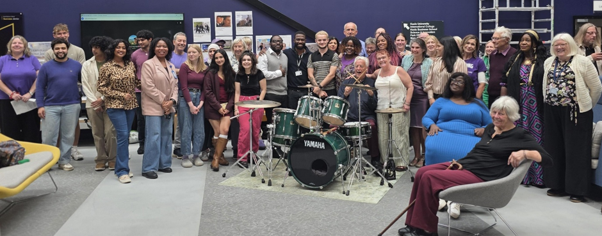
I had the opportunity to participate in the Asia-Europe Foundation Higher Education Innovation Laboratory (ASEFInnoLab7) White Paper Lab and Conference in August 2026 at the University of Nottingham. This year’s theme was “The Role of Universities in Advancing AI for Good”, and my group worked on a paper that explored the competencies required by different clusters within the University ecosystem to competently engage with AI.
On the final day of the conference, I was also invited, along with some other Early Career Researchers at the University of Nottingham, to give a “flash talk” on how our research spoke to AI and sustainability. After some soul-searching, I decided to focus on the analogies I kept encountering in my research between sex and technologies like avatars and Generative AI.
AI Discourse in Higher Education
My PhD doesn't engage extensively with AI, a fact I have mourned in the past. However, my research does explore the cultural, social and historical factors that inform how certain values and attitudes come to be accepted as law, with avatars as a case study.
One research method I have used is photo-elicitation. For example, I explored how female African Law PhD students thought about being female, being lawyers/law graduates, and being African in the UK by asking them to bring pictures related to these aspects of their identity.
In response to this task, one participant brought a selection of AI-generated images. When queried, they had this to say:
Nightmare Juniper: “Why AI? OK, I suppose after you clarified the instructions, I didn't want to use my images and I, I have been… from sort of the work that I've been doing, I sort of lean against using other people's faces, pictures if I don't know them. I won’t just go randomly on the Internet and pick another person's image or you know, another group of people and use them for a poster, use them for whatever […] so this is not a real picture and it's more ethical.
While it was unclear if this concern extended to images made available for use under Creative Commons licensing, it seemed that alongside being concerned about being identified as a research participant by anyone who might come across the project, they were unwilling to use online photos of strangers as well. Their perception of the harm-free nature of AI-generated images led them to believe they were more ethical.
I was familiar with the use of AI-generated images and videos for adverts and online entertainment as such use cases are commonplace in Nigeria even though sadly, the diversity of global techno-cultures and how they inform divergent, perhaps unusual, attitudes to AI remains under-researched, despite repeated calls. Many people also use AI tools to touch up amateur headshots for LinkedIn or professional websites. This was, however, the first time I had heard someone articulate a case for the use of Generative AI in ethical terms.
In the sessions that followed, I continued to ask participants about their perceptions of AI. Like many Global Southerners, they were quite optimistic, accepting AI as the unavoidable future. Many found it helpful for brainstorming, playing devil's advocate, and modelling the structure of an academic argument or paper. What they found unethical was the wholesale generation of chapters and articles with no unique, intentional or genuine input.
They were also concerned about how ‘AI in Higher Education’ discourse could lead to suspicions about or false accusations of AI use, sharing instances where this had taken place. They felt that AI was making it possible to freely cast aspersions on the intellectual abilities of black students like themselves under the guise of critique, when such statements may have been deemed impolitic to make openly until recently.
Participants understood academic anti-AI critique as less about an interest in knowledge and integrity, and more about the precarity academics are experiencing. Experiencing a lot of precarity themselves as international students, many of whom pursued an international education in the UK to better their lives, they wished for the conversation to reflect their concerns, challenges and views as well.
Having the Talk
Reflecting on these issues, one participant noted that the absence of clarity around AI design and use reminded her of how many African parents, like hers, refused to have conversations with their children about sex due to the belief that talking to your children about sex would make them promiscuous. In reality, of course, young people who are unprepared are at risk of getting the wrong information from their peers, the internet and strangers and are potentially more unsafe.

Participants in my study felt that in a world where more and more apps, like Grammarly and MS Office, now had Gen-AI features bundled in, where students were constantly bombarded with online ads promising to help their essays sound more “human”, and perhaps one where it is now impossible to do a Google search without AI results getting in the way, that the absence of clarity was deliberate.
Tracer Dye
When I gave a longer version of this talk at the Women in Law conference at the University of Nottingham in July, a concerned academic raised a hand to ask a question. They were struck by the fact that my participants felt they needed a tool to model the appropriate response to copy. It mirrored a similar struggle their own law students, who could not be convinced to develop and rely on their own writing, cognitive and reasoning skills without AI assistance, were having.
Over the past year, I have been using the framing of “AI as tracer dye” (apparently a modification of “AI as contrast dye”), which I first came across on Bluesky, a lot, and it immediately jumped to mind in response to this question. As I understand and have used it, tracer dye is a type of dye used to trace water flows within drainage systems, helpful for spotting if and when something is broken in the works.
The dye doesn’t solve the problem, though it could be part of the initial resolution process. I have found this a very useful, neutral illustration of how Generative AI functions, though quite a few people may have (mis)understood my description as positive.

My response, drawing a bit on semiotics and profilicity, was that it seems we now live in a world where the purpose of getting a degree is not to be educated, but to signal that we are educated. Job applications aren't screened, at least at the initial stages, based on substantive knowledge, but on symbols that signify such knowledge: a first-class degree, a CV, graduating from a prestigious University, a “non-ethnic” name, etc.
Today, what matters is the ability to signal value to an HR rep or an AI recruitment tool, whether or not that value exists. This state of affairs renders authenticity a hopelessly outdated mode of communication. Unfortunately, where, in the past, access to outsourced essays depended on how well-off a person was, or the extent they were willing to go to hire someone to do so, now, with LLMs, financial barriers and other frictional constraints to doing so have been eroded.
Beyond academic integrity, the leaky stain of AI use everywhere shows many systems to be badly broken in ways that are complexly interrelated across international education, migration, employment, global inequalities and much more.
Is there a way forward?
When I first came to Nottingham, I was struck by the ubiquitous A-Z of Consent signage in the city’s public spaces. The A-Z of Consent is a project by the Nottingham City Sexual Violence Action Network addressing issues arising from the digital mediation of love, sex, dating and romance. So, A is for Apps, F is for filming, U is for Upskirting, Y is for Yes, and so on.
Coming from a country as socially conservative as Nigeria, I found the signs rather jarring and gauche. But almost four years on, my perception of them and of Nottingham, a city with two universities and a large student population, is that they point to Nottingham as a place where people could talk openly about sexual violence and one where there was public, institutional support for these conversations and issues.
There are quite a few parallels here to the use of Generative AI, which is also used by lots of people globally. Certainly, my research participants' recommendations: (1) frank, open conversation that acknowledges ubiquity, ease of use and the absence of clarity about what type of usage is wrong, (2) a frequently updated handbook on AI use highlighting commonly used tools and their benefits and risks, and (3) a trusted faculty figure to take these concerns to, seem to draw on Comprehensive Sexuality Education approaches.
Indeed, the sex education story is reminiscent of the Black Vagina Cake story shared by another participant in a different study. These stories have been the highlight of my research in many ways. What the readiness-to-hand, so to speak, of sex analogies in my research seems to indicate is how embedded and intertwined these technologies are within our lived reality and experiences. They are tangible, common things we are able to make sense of and relate to in extremely personal, and some would say, private ways. Like sex.
Even more worth reflecting on, is the commonplace nature of the use of public health metaphors and therefore, potentially, interventions, in talking about the impact of various digital technologies today. We describe popular content as “viral” and AI-generated content as “slop”, talk about practicing “digital hygiene”, describe information literacy as “inoculation”, and describe the state of our media space as an “infodemic” or “toxic”.
Perhaps there's room for a public health-inspired approach to AI in higher education spaces that captures these issues at a population level, reflecting the different risks, levels of exposure, susceptibility, and precarity that various stakeholders experience as we move forward in the age of AI.


Comments