
Accountability in Custody: Law, Mental Health and Institutional Practice
Sarah Waite, Senior Lecturer in Criminology, Leeds Law School, Leeds Beckett University
Keywords: deaths in custody, mental health, prison, accountability, socio-legal studies

On 12 May 2026, Leeds Beckett Law School’s Centre for Justice, Law and Policy hosted Accountability in Custody: Law, Mental Health and Institutional Practice, an interdisciplinary seminar funded by the Socio-Legal Studies Association and delivered in partnership with LUNG Theatre.
The event brought together researchers, practitioners, students, artists and, crucially, family members who have experienced the death of a loved one in custody. Across the day, we explored questions of care, accountability, institutional responsibility, mental health and what it means to prevent future harm. The seminar was deliberately structured to move between different forms of knowledge, centring powerful short films and lived experience, before moving to interdisciplinary research and professional perspectives, and ending with a collaborative call to action.
Beginning with the voices of families
The morning began in the School of Arts cinema with two short films created by LUNG Theatre, drawing on the work and experiences behind Woodhill. LUNG’s production centres the stories of families affected by deaths at HMP Woodhill and the work is shaped by testimony from families whose loved ones died there (currently on tour). The films centred raw, emotive experience, ensuring people were at the heart of knowledge exchange and idea generation, rather than beginning with statistics, policy or institutional frameworks.
In the first film, a mother spoke about the death of her son, the experience of loss, and her family’s search for accountability. The names of other people who had died at Woodhill were also read aloud. It was a simple but powerful reminder that behind every statistic is a person, and behind every death are families whose lives are permanently changed.
The second film, Dear Prison Officer, addressed prison officers and the wider system directly. Its reflections included the contrast between a difficult day at work for a staff member and an event that becomes something a family carries forever. It also resisted an easy division between individuals and institutions - responsibility was understood as something more complicated than simply identifying a ‘bad person’. That complexity became a recurring theme throughout the day.
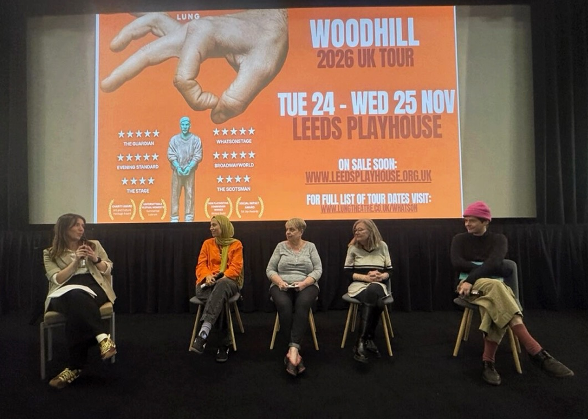
What does accountability mean to families?
Following the films, we held a panel discussion with family members and LUNG Theatre. The discussion returned repeatedly to experiences of communication, institutional culture and the feeling of being unheard or excluded following a death. Families spoke about the significance of small things such as communication, recognition, being treated as a person rather than a problem, and being given meaningful opportunities to ask questions and be listened to. These are not dramatic, costly interventions, yet they can have enormous and lasting significance for families.
The panel also challenged the tendency to think about deaths in custody solely through individual behaviour. Questions of responsibility extend across systems, organisations and professional boundaries. What happens when information is not communicated? What happens when organisations work in silos? What happens when responsibility is dispersed across multiple agencies? These questions are particularly important in a context where official bodies continue to identify concerns about deaths in custody and mental health. The Independent Advisory Panel on Deaths in Custody (IAPDC) has highlighted disproportionately high death rates among people in prison and people detained under the Mental Health Act, reinforcing the importance of scrutiny and prevention.
Bringing different perspectives into the room
After lunch, the seminar shifted towards research, professional practice and policy. Our first speaker, Michael Brown OBE , explored Right Care, Right Person and the relationship between mental health, policing and deaths following state contact. His contribution brought a critical perspective on the implementation and conceptualisation of policy intended to reduce inappropriate reliance on the police as responders to mental health crises.
Honor Garbutt then drew on her Master’s research highlighting the psychological consequences for prison staff following exposure to self-inflicted deaths, including the impact of occupational culture on engagement with support. This added an important dimension to the conversation arguing that staff wellbeing is not separate from questions of safety and care within prisons and the two are deeply connected.
Following this, Dr Doug Morrison brought a legal and mental health perspective, reflecting on the recurring language of ‘lessons learned’ following deaths. His contribution prompted consideration of what it really means for institutions to learn from deaths, and whether repeatedly identifying lessons is enough if those lessons do not translate into meaningful change.
Together, the afternoon demonstrated the value of bringing different professional and disciplinary perspectives into the same conversation. No single discipline could adequately address the questions raised by the films and family experiences.
Beyond ‘lessons learned’
One of the tensions running through the day was the familiar language of learning lessons after a death. There is an obvious value in identifying what went wrong and what might be done differently but the attendees considered the risks when ‘lessons learned’ become endpoint rather than a process. The question is whether lessons are acted upon, by whom, and with what mechanisms for accountability.
This connects with wider debates about the response to state-related deaths. LUNG Theatre’s Woodhill work, for example, has developed beyond the theatre production into ongoing campaigning work with the Woodhill Families Group. The families’ involvement is central to this work and demonstrates the collective power of lived expertise for ongoing campaigning, training and demands for institutional change.

Making space for students and new perspectives
The seminar also included students from Leeds Law School, alongside colleagues and visitors from different institutions and professional backgrounds. This varied audience was crucial to ensure the event did not just become conversations between established academics and policymakers. Bringing students into the room creates a different kind of exchange and impact. Students were able to hear researchers and practitioners disagree, question assumptions and talk about the areas they are passionate about. Feedback afterwards highlighted the value of seeing those different perspectives brought together. For us, this is an important part of socio-legal education, creating opportunities for people to encounter the complexity, uncertainty and human consequences of those criminal legal systems.

Capturing the day differently
We also wanted to experiment with how an interdisciplinary event could be documented and draw upon the importance of creative methods in knowledge exchange and generation. Throughout the seminar, Leeds Beckett School of Arts student Bethany Hewines created live visual minutes, capturing ideas, questions and themes as they emerged. At the end of the seminar, participants took part in a collective activity focused on moving from reflection to action.
Using Padlet, they considered what had stayed with them, what needed to change, and what practical action might follow. The resulting materials, including the visual minutes, Padlet contributions and a collaboratively produced zine, form a record of the day that is deliberately different from conventional conference proceedings. The zine is particularly important to us because it gives participants something tangible to take away and continue working with.
Continuing the conversation
The response from participants suggested that the value of the day lay not simply in the individual presentations, but in the opportunity to put different forms of knowledge alongside one another. After the event, LUNG Theatre shared feedback from the families involved, describing the seminar as one of the spaces where they had felt particularly welcomed and where they felt participants took their words and wishes seriously. They reflected that, despite the structural and political challenges surrounding deaths in custody, hearing practitioners and researchers share their work could help people ‘move forward’ and take responsibility for their own part in the change they want to see.
The seminar aimed to create a space where different forms of expertise could meet, lived expertise alongside academic research, legal analysis alongside professional practice, creative work alongside policy discussion, and student perspectives alongside those of practitioners. The challenge now is what happens beyond the seminar. If accountability is to mean more than identifying lessons, then the knowledge generated through these experiences needs to travel into research, teaching, professional practice, institutional decision-making and policy.
Acknowledgements
We would like to thank the Socio-Legal Studies Association for funding the event; LUNG Theatre and the Woodhill families for their generous contribution; Leeds Law School and the Centre for Justice, Law and Policy; the School of Arts for hosting the morning film screening; all of our speakers, contributors and attendees; and Bethany Hewines for their creative contributions to the day.
Further information
Find out more about LUNG Theatre’s Woodhill tour, including CPD workshops and post-show panels, and the Woodhill Families Group: LUNG Theatre – Woodhill.



Comments