
“Law is a cabaret, old chum” - How Law’s a Drag uses theatre for engagement and outreach, and how you could too
James Greenwood-Reeves (aka Alice Aforethought), Lecturer in Law, University of Leeds
Rosie Fox (aka Fox Populi), Lecturer in Legal Education, University of Leeds
Keywords: gender, queer, drag, theatre, impact

It might seem unsurprising that Law’s a Drag would use live performances to share its research and engage with the public. Why wouldn’t we?! As a network that seeks to learn more about how drag artists experience law and (in)justice, it would be foolish not to make use of the glamour, excitement, and visual appeal of this art form. Artists in the network have also been very clear that, in terms of research outputs, performance art should be key to our mission, and that artists should be given wide creative freedom in how their shows take place. This gives us all the more reason to, quite literally, put on a show.
But this celebration of drag - and the use of performance as a technique of public engagement - need not be the sole province of the LAD project. Academics can learn key skills from drag artists in how to develop their research profile, speak to the public, share ideas in an engaging format, and excite people about their work. Here, we reflect on a couple of our recent shows and hopefully inspire you to think about joining our network - or to discover your own way to empower artists and dynamically transform your research.
Engagement: a queer ‘History of Love’
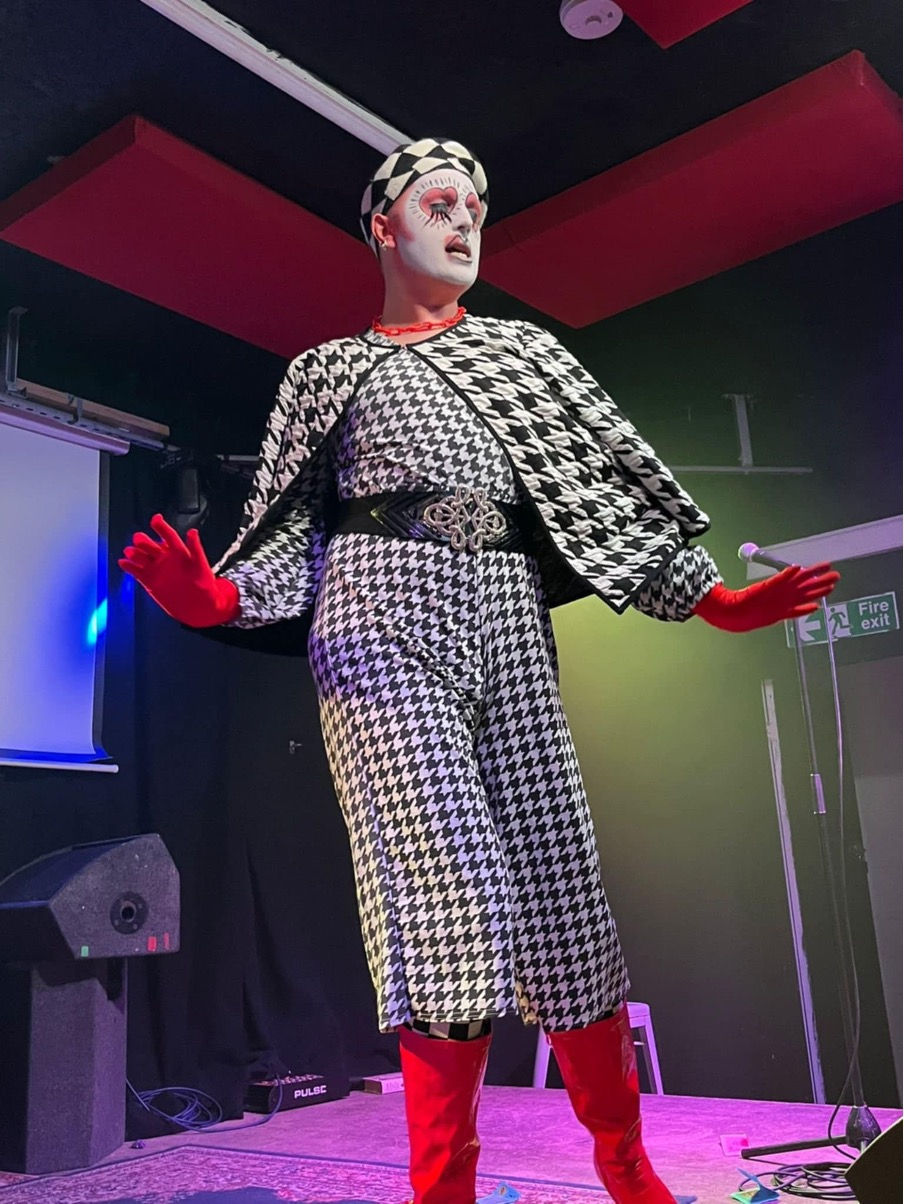
Our latest show, in February 2026, was a great example of combining forces to help share research with the general public. We previously discussed with artists in our network the notion of having an LGBT+ History Month event, and one of our members, Pembo, suggested a “History of Love”.
Taking this on, the “legal dragademics” of the network - Fox Populi and Alice Aforethought - put together a script that narrated the legal history of queerness in the UK. It included historical criminalisation of homosexual acts, the trials of Oscar Wilde and Alan Turing, the law’s failure to recognise lesbian relationships, and the modern law on trans and nonbinary identities.
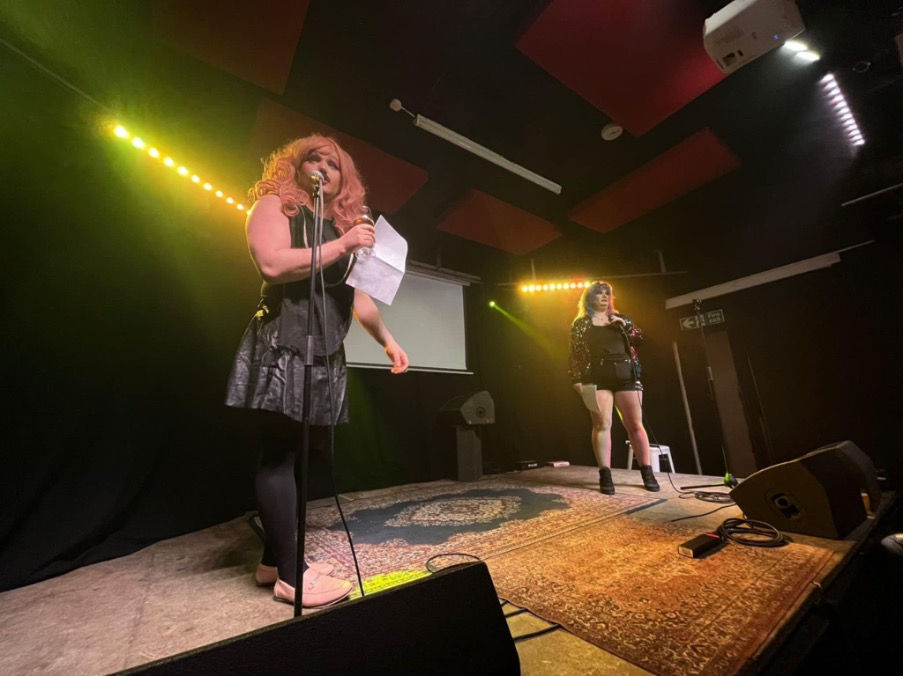
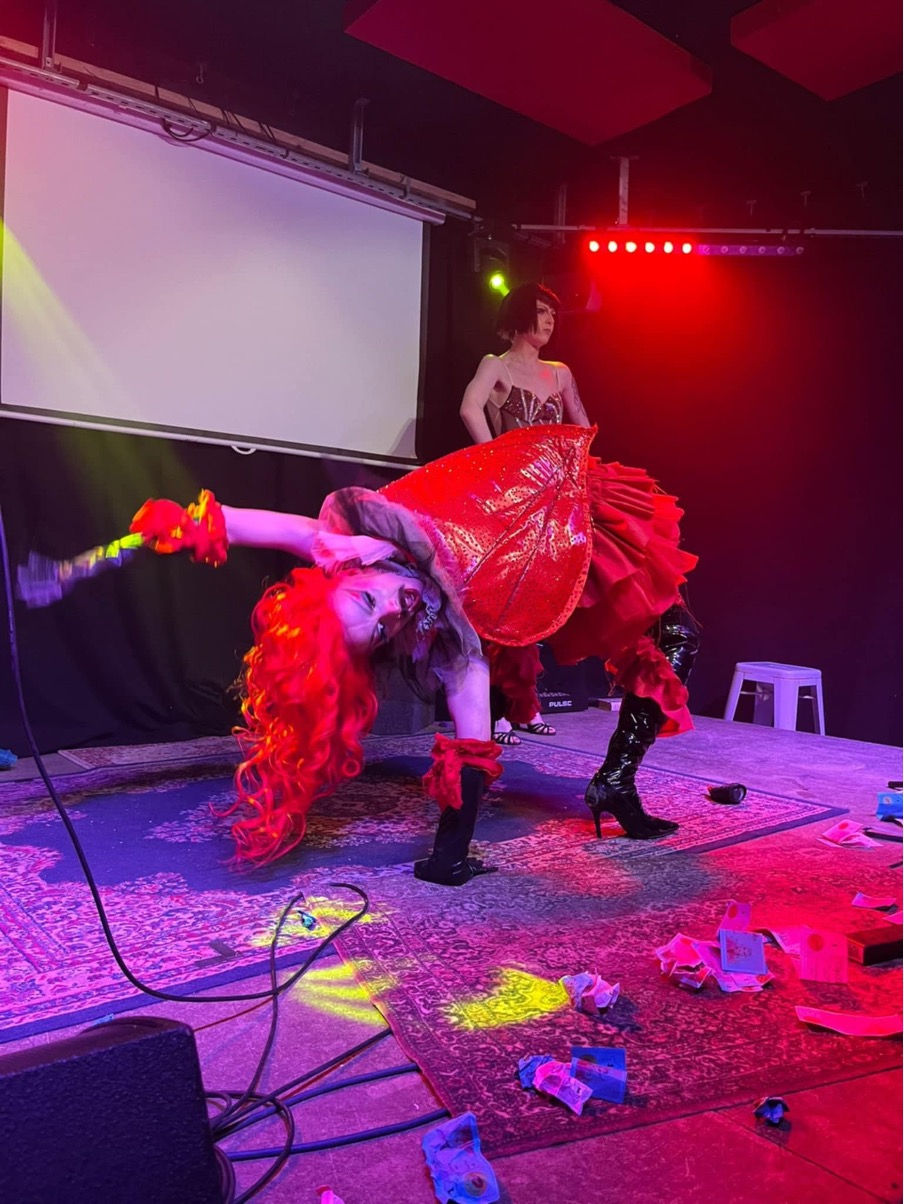
Artists in our network then devised relevant performances to help convey their own messages within this framework. Fae Fatale created a video and lip sync routine based on Virginia Woolf’s Orlando and Woolf’s relationship with Vita Sackville-West. Pop Tart portrayed the 1980s with songs by Freddie Mercury and Erasure. The Haus of Reason (ft. Pembo, Mattress, and Laila Gaga-Parker) gave performances relating to drag houses as ‘found families’, in the absence of formal legal recognition of queer relationships in the 20th century. Finally, as dragademics, we also performed numbers on bisexual visibility and gay marriage, featuring tracks by Sub-Radio, Superfruit, and Raye’s iconic ‘WHERE IS MY HUSBAND!’.
The audience was motivated and enthusiastic. They were singing and dancing to the songs, tipping the performers, and taking photos and videos to share on social media. They also heckled at mentions of Thatcher and section 28, booed the House of Lords blocking the Bill to equalise the age of consent, and cheered at the arrival of same-sex marriage.
Ask yourself: when was the last time an absolute stranger audibly gasped at something you’re researching? When was the last time someone cheered when you told them about a change to legislation that took place a decade ago? And when have you ever had a room full of people boo your enemies?
While there are clear reasons why we at LAD should use drag to convey our research to the public, given both our network and our queer focus, you could find it useful whatever your specialism. Drag allows you to develop a separate persona, who can speak more boldly on your behalf. Drag encourages parody, playfulness, and creative expression. And whether you choose to use drag, or other theatrical methods (community theatre, pantomime, forum theatre, or even burlesque), you could use performance as a spark to ignite the imaginations of your audience and inspire engagement that you might struggle to attain through mere printed words alone.
Impact: F*** For Women Scotland

Live performances are also great opportunities to seek clear, measurable impact. In 2025, on the encouragement of our artist members, we hosted a cabaret in response to the For Women Scotland judgment, in which the UK Supreme Court defined sex in the Equality Act 2010 by reference solely to male or female categories determined by “biological sex.” Many members of the drag community, and those they love within the LGBTQ+ community more widely, identify as trans or nonbinary, so this decision was causing (and continues to cause) a great deal of fear and uncertainty among them. We decided to hold a cabaret, fundraising for the Good Law Project’s trans rights fighting fund.
Not only did this showcase the talents of our artists and help us convey our ongoing research on the subject to an affected audience, but it also allowed us to demonstrate clear impact potential in terms of fundraising, community resilience building, and contributing to an ongoing legal dispute. Using live performance allows you to state clear goals, ask attendees for feedback about what they’ve learned, demonstrate a growth in your network, and - importantly - springboard from your live event to show a clear desire for change. And again, while drag is a powerful and versatile art form for the purpose, your own impact goals can be advanced through other theatrical methods.
Put on your heels
The benefits of using drag and performance to share your research, and to inspire change, are clear. But how do you practically go about developing these plans, and putting them into action - particularly if you have little live performance experience?
First, remember that you won’t be working alone. You don’t need to reinvent the wheel: you can find drag artists, theatrical troupes, a studio of artists, or even a student society, and reach out to them. You can even reach out to us at LAD.
Artists are the real experts in how to put on a show. Ask them if they might be interested, support their ongoing projects, and use your research project to provide them with opportunities to showcase their work. They may even be able to help you develop your own performance skills! Developing a mutually beneficial relationship takes time. You need to make sure they tell you what they want and need, and you need to reimburse artists for their time and expertise: you may be able to use impact and engagement funding pots for this work. You need to maintain this mutual support network outside of your own project, too: support local artists, share their work and their upcoming events, and earn that trust.
Second, try to have clear goals (however small) for each performance. It could be about informing a local community, showcasing a new network, demonstrating appetite for further work, raising public awareness of the great work your artists are making, or building a portfolio of community engagement projects.
Think about how you are going to make the case to increasingly parsimonious university managers that this time, effort, and money is worthwhile. It helps if you can come away with clear evidence - whether that means audience surveys, tickets sold, or simply photos and videos from the night - and better yet if you can hire a photographer/videographer within the community you are working with. If you can have the performance recorded (with everyone’s consent), and in decent audiovisual quality, all the better for future documentary purposes.
Third, have fun. This is not some generic piece of friendly advice: it is vital that you have fun. The neoliberal academy squeezes out anything considered frivolous in the pursuit of efficiencies and measurable outputs - and it will destroy you if you let it.
Play, fun, and joy are how we resist that oppression. It is what breathes life into our work and demonstrates to others inside and outside the university that what we do is worthwhile. It also makes your work more approachable and conveys confidence in your research and in the network of artists with whom you work. Foster that confidence and let the joy shine through.
As our artists wrote in the Law’s a Drag research outputs manifesto, you must “Serve c*** to the highest degree… or else.”


Comments