
A Sound Legal Education: Musical Storytelling on Queer Love, Life and the Law
Updated: Sep 29
Transformative, creative pedagogies are urgently needed in legal education. Far from the cutting-edge of pedagogical practice, legal education is heavily shaped by conservative notions of ‘professionalism’. This, in turn, has often constrained the pedagogical imagination of staff who teach in the field. Where cutting-edge practices are present, they are rarely captured in literature on legal education. Increasingly, scholars and practitioners are pushing for changes in legal education that could enable students to learn differently, creating forms of ‘professionalism’ that demonstrate a deep commitment to social justice and inclusivity. In this blog series, Who said that learning law is boring? Bringing Creative Teaching Methods into Legal Education, we explore how arts-based, affective and embodied teaching methods can deepen students’ learning of law and enrich socio-legal teaching. These blogs start from the premise that everyone is creative, and that taking creative approaches to legal education can build critical analytical, vocation, and civic skills. Read more about the blog series and our motivations here.
SJ Cooper-Knock, University of Sheffield and Katie Jukes, Manchester Metropolitan University
Keywords: Music, Musical storytelling, queer love, queer law, creative pedagogies.

Over the last year, we have been co-leading a project with Surabhi Shukla and Fiona Moorcroft, exploring whether music and poetry can help to build understanding, community, and solidarity – both within and beyond LGBTQ+ communities. We are now applying that learning to legal education and creative pedogogy.
Our focus in the project was queer love, life, and the law. Queer love can take many forms, including self-love, friendship, familial love, sexual love, and romantic love. The law can play an important role in building, protecting, or persecuting these different forms of love.
Currently, in the UK, hate crimes against LGBTQ+ people are on the rise and key rights are being challenged. Therefore, it is crucial that we understand the diverse experiences and struggles that queer folk encounter, working toward a future in which everyone can be equal, safe, and free.
Sometimes this can feel difficult. Discussions around sexual orientation and gender identity can feel polarised. This can be true within the classroom, the workplace, and the public sphere.
Our project asked whether creative approaches to such conversation could provide a productive way forward. In doing so, we were also thinking creatively about what it means to learn about the law, and where that learning can happen.

Learning Through Creativity
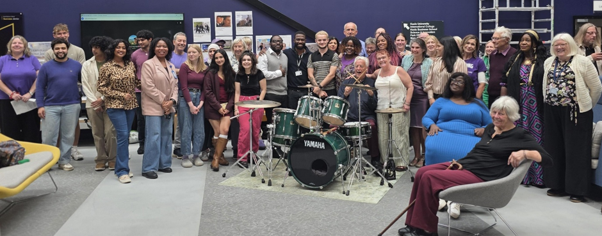
In November 2025, we held workshops in Bradford and Sheffield. These workshops helped LGBTQ+ participants to share their stories creatively, through songs or poetry set to music. We call this ‘Queer Musical Storytelling’.
The workshops lasted for a weekend. Reflecting on the process with us, participants emphasised the multiple forms of learning that occurred during the time we shared together.
First, participants learned from each other. Each workshop brought together folk with a diverse range of lived experiences and identities. Workshops began with discussions in which participants reflected together on what queer life, love, and the law meant for them: the weight and worth of different labels; the varied ways that they had nurtured love in their lives; and how the law worked its way into their fears and their dreams.
Second, participants learned how to craft their own stories into words and tunes with our wonderful facilitators. They played with sound and syntax to find new ways of telling stories that may have felt too complex, sharp, or difficult to share. They were supported to refine their words with care, while also being free to follow unexpected paths and see where they led.
A third form of learning emerged from this work: the capacity to learn from their own stories in new and different ways. As one participant reflected, “I feel as if I have captured 10 years of therapy in three minutes of song”.
This, then, was the first site of learning on queer love, life, and the law: learning that happened in the midst of the creative process.

Creative Learning Beyond the Workshop
The second site of creative learning within our project happened as we shared songs from our participants with members of the public, at Pride events and in our public exhibitions.
Members of the public were given the opportunity to listen to a range of different genres, covering diverse lived experiences. Learning, in this context, meant learning about the experiences of other folk within LGBTQ+ communities.
For some, this was an opportunity to learn that they were not alone in their struggles: that fights to gain access to gender-affirming care, to navigate adoption, or to have polyamorous kinships recognised by the state were shared by others. This was learning that felt like companionship.
For others, it was an opportunity to learn about lived experiences different from their own: an opportunity to reflect on the need for solidarity with LGBTQ+ folk who are harmed or deserted by the law in ways that they were not. This was learning that felt like a clarion call for mobilisation and change.
In both cases, listeners relished the opportunity to learn from musical storytelling within LGBTQ+ communities. It brought home again the importance of representation in storytelling.

Creative Learning Within Legal Education
And finally, our work has taken us back to the law classroom: a site in which there is still too little discussion of queer life and the law and, when these discussions happen, it is too often focused on harm and discrimination alone. This is also a site where very often creative pedagogy is absent.
By placing love and life at the centre of this project, we create space for people to explore questions of discrimination and harm without losing sight of the fullness of queer life, which also includes love, joy, resistance, and community.
By taking musical storytelling into the legal classroom, we provide law students and teachers with the opportunity to learn about the diverse roles that the law can play in shaping queer life, in all its glorious complexity. We also provide an opportunity for students and teachers to learn and develop their creative skills, enhancing their sense of agency and belonging.
In this model of learning and teaching, by pairing different pieces of musical storytelling with legal cases and principles, students are able to grapple with the importance of legal doctrine while also appreciating that texts alone can tell us little about how the law is animated in everyday life. These songs tell stories about inheritance rights and wrongs, non-traditional kinship bonds, polyamory, gender-affirming medical care.
The protections that the law can offer mean little if LGBTQ+ people risk being abused by the police to whom they seek to report a case. Similarly, the sharpened edge of legal persecution can be blunted when queer folk draw on centuries of strategies and solidarities to evade, resist, and subvert it.
The law has a long history of drawing people’s life stories into the courtroom and contorting them through a legal lens. Queer Musical Storytelling reverses this trend: it drags the law into queer words and song, inviting students to make sense of the law through a queer lens. In this classroom, all students have the opportunity to learn how to use their own voices to interpret and understand their lived experience of the law.

Conclusion
In this brief blog, we hope that we have shared some of the key ways in which we can learn from queer musical storytelling, both as storytellers and as those who hear these stories. Our work has helped us think creatively about what it means to learn about the law, and how this learning can take place.


Comments